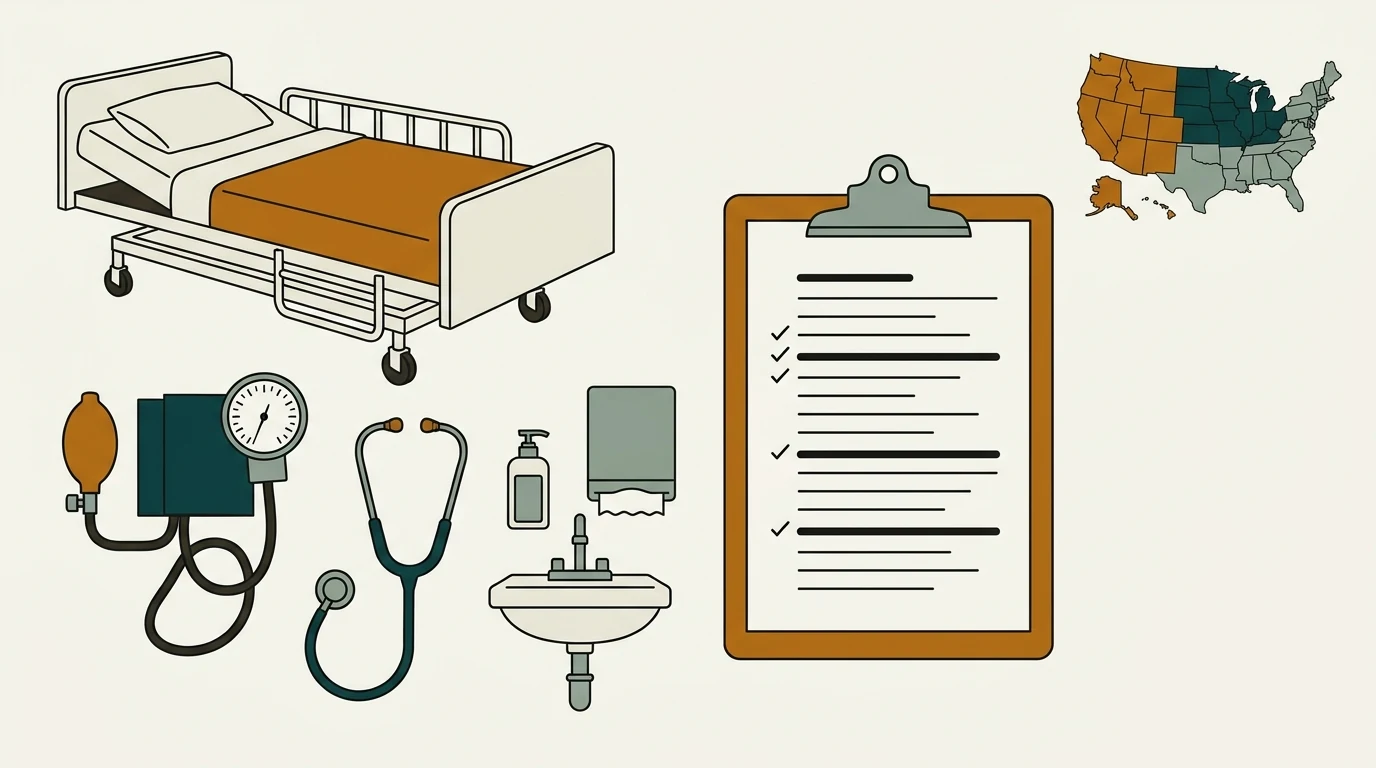
There is no single CNA state exam. Your state hires a testing company, and the company decides how many questions you get, how long you have and how the skills test is graded. Depending on where you test, the written part is anywhere from 60 to 79 questions.
The other surprise is which half is hard. Most candidates worry about the written test, but the skills test is the one that fails people. In the states that use the most common exam, about one candidate in eight fails the written part and about one in four fails the skills part. This post shows you how to find your testing company, what its exam looks like, and why the skills test is where you should put your practice time.
Step One: Find Out Who Gives the Test in Your State
Every question about your exam starts with the company your state uses, so look that up before you read any study guide. Most states use one of three national companies; a handful run the test themselves or use a smaller contractor. As of October 2026, from each company's own list of states:
| Testing company | States |
|---|---|
| Credentia (the NNAAP exam) | Alabama, Alaska, Colorado, Georgia, North Carolina, Pennsylvania, Rhode Island, South Carolina, Tennessee, Virginia, Washington |
| Headmaster (D&S Diversified Technologies) | Arizona, Arkansas, Massachusetts, Michigan, Minnesota, Mississippi, Missouri, Montana, Nevada, New Mexico, North Dakota, Ohio, Oregon, South Dakota, Utah, Wisconsin, Wyoming |
| Prometric | Connecticut, Delaware, Florida, Hawaii, Idaho, Louisiana, New York, Oklahoma, Texas |
| More than one approved company | California, District of Columbia, Iowa, Maryland (your training program usually tells you which one) |
| Other arrangements | Illinois (Southern Illinois University Carbondale), New Jersey (PSI for the written test, Headmaster for the skills test), New Hampshire and Vermont (Excel Testing), and Indiana, Kansas, Kentucky, Maine, Nebraska and West Virginia, which run the test through state programs or their own contractors |
States do switch companies. New Mexico and Michigan, for example, both moved from Prometric to Headmaster in recent years, so a study guide or video from a few years ago may describe a test your state no longer gives. Your training program and your state's nurse aide registry are the final word. Once you know the company, download its candidate handbook for your state. It is free, and it is the only document that describes your actual exam.
How Many Questions Are on the CNA Exam?
The question count is set by the testing company and sometimes by the state, which is why answers online disagree. Here is what each company's current handbook says.
| Exam | Written questions | Time | Skills test |
|---|---|---|---|
| Credentia NNAAP | 70 (60 scored, 10 unscored trial questions) | 2 hours | 5 skills, always including hand hygiene and one measurement skill |
| Prometric (Florida handbook) | 60 | 90 minutes | 5 skills scored: 3 assigned tasks plus handwashing and indirect care on every test |
| Headmaster | Varies by state: 70 in Minnesota, 75 in Arizona, 79 in Ohio | Varies by state | 3 or 4 tasks; the first always includes hand washing with soap and water |
| PSI (New Jersey written test) | 60 | 90 minutes | Given separately by Headmaster, and must be passed first |
Sources: Credentia NNAAP exam overview; Prometric Florida CNA candidate bulletin; Headmaster Ohio candidate handbook; Minnesota Department of Health; New Jersey Department of Health.
The unscored questions on the NNAAP matter more than they sound. Ten of your 70 questions are being tried out for future exams and don't count, and you can't tell which ones they are. If a question seems strange or covers something you never studied, it may be one of them. Answer it, move on, and don't let it shake you.
Credentia, Prometric, Headmaster and PSI all offer an audio or oral version of the written test, where the questions are read aloud, if you choose it when you apply or schedule. The NNAAP oral exam adds 10 reading-comprehension questions to the 60 scored ones. If reading under time pressure is your weak spot, ask your program about it before you register.
Is the CNA Exam Hard? The Skills Test Is the Hard Part
The written test is passable for nearly anyone who finished a training program; the skills test is where candidates actually fail. The National Council of State Boards of Nursing (NCSBN) last published national results for the 2023 testing year: 88% of candidates passed the written or oral exam, but only 75% passed the skills evaluation. The year before was nearly identical, at 87% and 74%.
Source: NCSBN, 2025 Annual Meeting Business Book, "Summary of NNAAP Examination Results for Calendar Year 2023". These figures cover NNAAP states only; Headmaster and Prometric states publish results by training program rather than as one national figure.
The gap comes from how the skills test is graded, not from the skills being difficult. Every skill has a short list of required steps, printed in bold in the handbook. Credentia calls them critical element steps and Headmaster calls them key steps. Miss one, or do it wrong, and you fail that skill no matter how well you did the rest. You also have to pass every skill on your test, not most of them. A candidate who does four skills perfectly and skips one bold step on the fifth fails the skills test.
Headmaster adds a second requirement: on each task you must do every key step and at least 80% of the other steps. Prometric scores handwashing and "indirect care" (residents' rights and preferences, communication, safety, comfort and infection control) across your whole test, on top of the three tasks you're assigned. Florida's bulletin says plainly that the evaluator will not prompt you to wash your hands. You are expected to know when to do it.
What Happens If You Fail One Part
Failing one part of the exam costs you a retest fee and a few weeks, not your certification. With every company here, if you pass the written test and fail the skills test (or the other way round), you retake only the part you failed.
Federal rules guarantee at least three tries. Under 42 CFR 483.154, you must be told which areas you failed and given at least three chances to pass, and a state may set a limit but not one lower than three. Many states stop at three. After three failures on the same part, you usually have to repeat a state-approved training program and then take both parts again. In Florida that means a program of at least 120 hours.
Prometric's Florida candidates have an option most people don't know about. If you fail the written test, you can pay $30 for a supervised review within 60 days, where you see a printout of the questions you missed, your answers and the correct answers. If your state's handbook offers something similar, use it before you retest. It tells you exactly where your gaps are.
How to Spend the Weeks Before Your Test
Put your practice time where the failures are: most of it on skills, enough on the written test to be comfortable.
- Get your own handbook. Confirm your testing company with your program, then download that company's handbook for your state. Its skills list and bold steps are what you'll be graded on.
- Drill the skills with a partner. Have someone read the bold steps while you perform each skill, including measurement skills like counting a pulse or reading a blood pressure, and the handwashing that comes before and after.
- Take timed written practice. Our free CNA practice test follows the written exam's topic areas and explains every answer, so you can find weak areas early.
- Know your retake rules before test day. Knowing that one failed part means a retest, not starting over, takes a lot of the pressure off.
If you're still deciding whether the certificate is worth the time, our look at whether a CNA is worth it in 2026 covers pay and openings, and the CNA-to-LPN break-even math covers the most common next step. If you might move after you're certified, check how CNA certification transfers between states first, and see the CNA hub for the full path from training to registry.