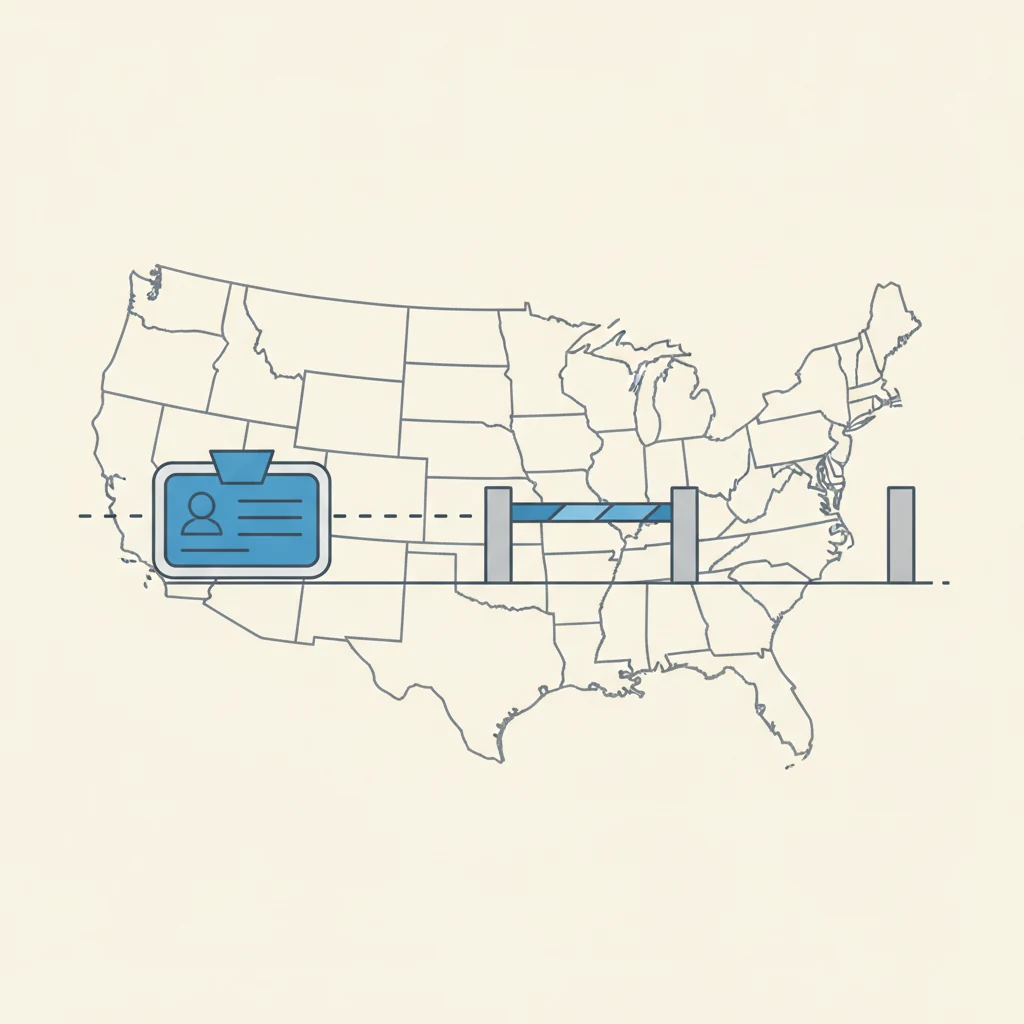
Two certified allied-health workers leave Ohio for Texas in the same moving truck. One is a certified medical coder; the other is a certified pharmacy technician. The coder opens a laptop in Houston and is legally working that afternoon. The pharmacy tech — same kind of national certification, same clean exam record — cannot legally touch a prescription until Texas issues a separate state registration, which means a new application, a fee, and a wait.
Same word on both résumés — "certified" — and opposite outcomes at the state line. The difference has nothing to do with "reciprocity," the term almost everyone searches for. It comes down to one thing most guides never name: whether your state bolts a registration layer on top of your certification. That layer, not the certification, is the only thing that can get stuck at the border.
Your certification was never the thing that crosses the border
Here's the reframe that makes the whole question simpler. A national certification — the CPhT from the Pharmacy Technician Certification Board, the CPC from the AAPC, the CDA from the Dental Assisting National Board, the CCMA from the National Healthcareer Association — is a private credential. A testing body, not a government, issues it. It certifies that you passed an exam. It carries no legal authority to work in any state, and, just as importantly, it has no geographic jurisdiction to lose.
That means a national certification doesn't need "reciprocity" in the way a license does, because it never belonged to a state in the first place. There is nothing for State B to recognize or refuse — the credential simply travels with you the way a college degree does. (If you're fuzzy on why a certification and a license are legally different animals, we break that down in certification vs. license: what you legally need to work.)
A license or state registration is the opposite: a government permission slip, valid only inside the borders of the state that issued it. When people ask whether their credential "transfers," this is the piece they're really worried about — and whether it exists at all depends entirely on your role.
The real border is your state registration layer
So the useful question isn't "does my certification transfer?" It's "does my state — and the state I'm moving to — require a separate registration on top of my certification?" For certification-based allied-health roles, the answer runs from "never, anywhere" to "almost always." Think of it as a portability ladder:
| Role & national cert | State registration layer? | Practical portability |
|---|---|---|
| Medical coder / biller (CPC, CCS/CCA) | None in any state | Move freely — no state credential to redo |
| Medical assistant (CMA, RMA, CCMA) | One state (Washington) | Nearly always portable |
| Phlebotomist (CPT, ASCP, AMT) | Four states (CA, NV, WA, LA) | Portable in ~46 states |
| Dental assistant (CDA) | Depends on duties (radiography / expanded functions) | Mixed — basic chairside travels, permits don't |
| Pharmacy technician (CPhT, ExCPT) | Nearly every state | Re-register on every move |
Read the ladder top to bottom and you can see the thesis at work: the certification is identical in kind at every rung — a national exam credential — yet the mobility outcome is completely different. What changes is the height of the state layer stacked on top.
Medical coder: the top of the ladder
No U.S. state licenses medical coders or billers. The medical coder reciprocity picture is the simplest in allied health: your AAPC or AHIMA credential is all the market asks for, and since there's no state permission slip to obtain in the first place, there's nothing to re-obtain when you move. This is the purest illustration of the whole point — a role where "reciprocity" is genuinely a non-question.
Medical assistant: one exception to remember
In roughly 45 states, medical assistants aren't licensed at all, so a medical assistant moving states keeps working on the strength of the CMA, RMA, or CCMA alone. The one true exception is Washington, which requires a state medical-assistant credential before you perform clinical duties. A handful of other states don't license the role itself but do gate specific tasks — New Jersey and South Dakota, for example, require certification before an MA gives injections. The credential travels; a few task-level rules don't.
Phlebotomist: four states that actually regulate the needle
Phlebotomy is the classic "it depends where" case. Only four states impose a state-level credential on top of your national certification: California (the CDPH Certified Phlebotomy Technician I), Nevada (a lab-assistant certificate), Washington (the Medical Assistant-Phlebotomist credential), and Louisiana (through the state Board of Medical Examiners). In the other ~46 states there is no state phlebotomy credential at all — the NHA, ASCP, or AMT certification is an employer expectation, not a legal requirement. So the phlebotomist reciprocity question really reduces to a single check: am I moving into or out of one of those four states?
Dental assistant: portability that depends on what you do
Dental assisting splits down the middle. Basic chairside assisting is often unregulated, but the moment you take radiographs or perform expanded functions, most states require a state-specific permit — a Registered Dental Assistant or Expanded Functions credential — and those do not travel. A dental assistant relocating with the national DANB CDA keeps the certification, but may have to re-earn a state radiography or expanded-function permit to do the same duties in the new state. Here the "layer" isn't a single yes/no — it's duty-by-duty.
Pharmacy technician: the bottom rung, and the reason this post exists
Pharmacy techs are where the reciprocity confusion peaks, because the CPhT is one of the most nationally recognized allied-health certifications there is — and yet mobility is the hardest on this list. Nearly every state requires pharmacy technicians to register or license directly with its Board of Pharmacy before working, and that state registration is issued by that state, for that state. It does not transfer. The certification you earned once follows you for life; the state registration is a fresh application in every state you move to. That's the exact split the pharmacy tech reciprocity guide maps out state by state — and it's why a certified tech can be "certified" everywhere and still legally grounded the day they arrive somewhere new.
The second, quieter border: employer preference
Even where no state layer exists, "portable" doesn't always mean "frictionless." Certification bodies compete, and regional job markets develop preferences. In some metros, hospital labs lean toward ASCP over NHA for phlebotomists; some coding departments advertise for AAPC's CPC while others want AHIMA's CCS. None of that is a legal barrier — your credential is valid — but if you land in a region that favors the badge you don't hold, you may feel a soft version of "my certification didn't transfer" that has nothing to do with any state board. It's worth knowing which certifying body dominates where you're headed before you assume day-one portability.
Why the compact headlines don't apply to you
If you've read about interstate compacts letting nurses or EMTs work across state lines on one license, don't expect the same for a certification. The Nurse Licensure Compact, the EMS Compact (REPLICA), and the Counseling Compact all govern licensed professions — and none of the five roles above is covered by any interstate licensure compact. (The emerging Dental & Dental Hygiene Compact covers dentists and hygienists, not dental assistants.) We map which credentials actually get a compact in licenses that travel: which credentials have multistate compacts.
The other headline — universal license recognition, now enacted in more than 20 states and recently expanded in Virginia, whose HB1117 cut the prior-holding requirement from three years to one effective July 1, 2026 — is also mostly a licensing story. These laws streamline recognition of an existing license from another state. If your role is certification-only with no state layer, there's no out-of-state license to recognize, so the law simply doesn't touch you. For the roles that do carry a state layer (pharmacy tech, the four phlebotomy states), universal recognition can occasionally help — but it's a per-state, per-profession detail, not a blanket free pass.
Before you move: a three-question check
Skip "does my certification transfer" — it's the wrong question, and it hides the one that matters. Ask instead:
- Does my current state make me hold a separate state registration or license to do this job? If no (coder, MA outside Washington, phlebotomist outside the four states), you had nothing to transfer to begin with.
- Does the state I'm moving to require one? This is the only question that can actually block you. Check the destination's board directly, or start with that role's reciprocity page here.
- Does my certifying body match what employers in the new region prefer? Not a legal gate, but the difference between an easy job search and a frustrating one.
Answer those three and you'll know exactly what — if anything — you have to redo. For most certification-based allied-health roles, the honest answer is "nothing." For pharmacy techs, it's "a new state registration, every time." Either way, it was never the certification that traveled or didn't. It was the layer on top.