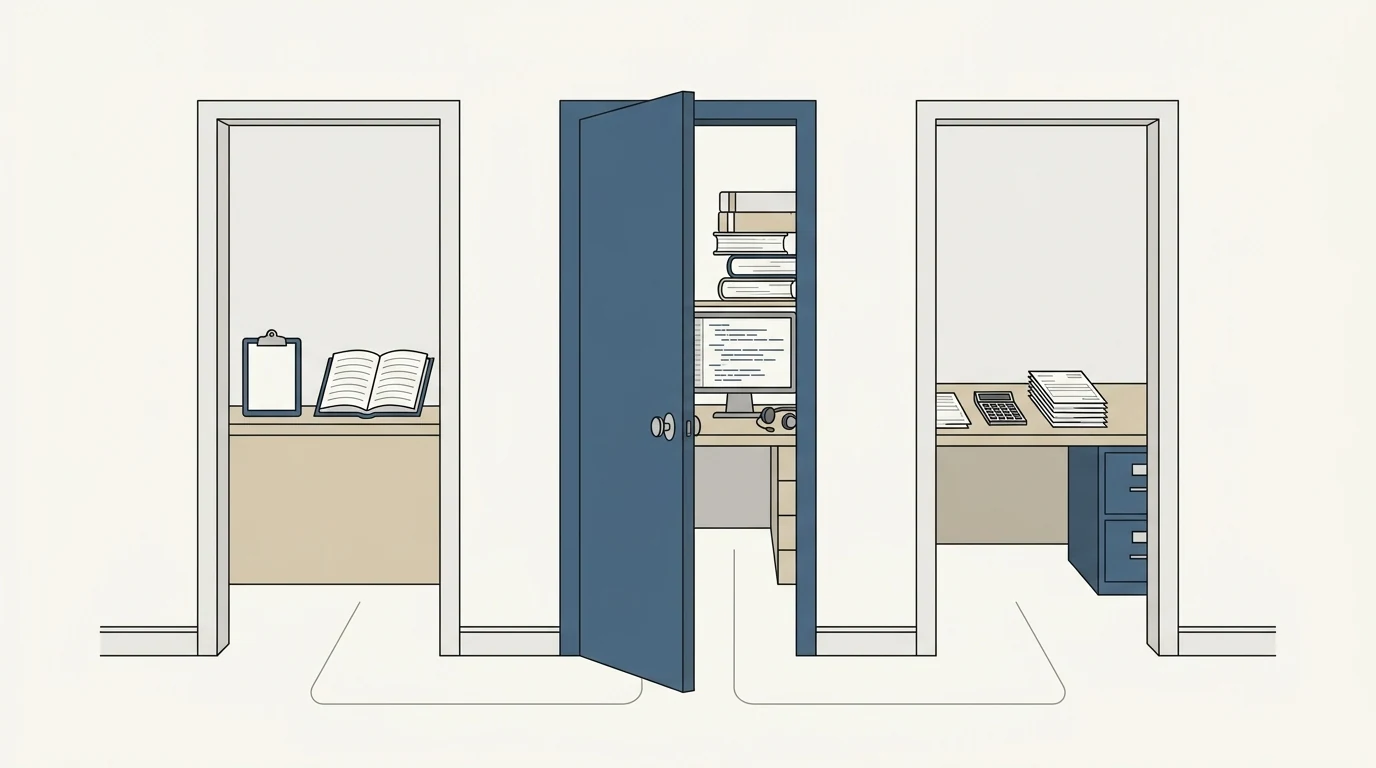
Medical coding is worth it as a place to end up and a poor place to start. Experienced coders out-earn the front desk, billing and medical assistant jobs around them, and the work is quiet, desk-based and sometimes remote. The trouble is getting the first coding job. The coding course and the exam are the easy part, and many people who finish them can't get hired.
Coding schools sell the exam as the way in. For most career changers with no healthcare background, it is the second step. This post explains why and sorts readers into four situations, each with a different first move.
The Destination Pays; the Door Is Small
Coding's pay advantage is real, and it grows as you gain experience. BLS groups medical coders under medical records specialists (SOC 29-2072). At the low end of the scale they earn about the same as the office and clinical jobs next to them. By the middle of the scale they are several thousand dollars a year ahead, and the top 10% clear $80,000.
| Occupation (BLS, May 2025) | 10th percentile | 25th percentile | Median | Projected openings a year |
|---|---|---|---|---|
| Medical records specialists (includes coders) | $37,000 | $43,490 | $51,140 | 14,200 |
| Medical assistants | $36,050 | $38,470 | $45,690 | 112,300 |
| Medical secretaries and administrative assistants | $35,050 | $37,880 | $44,640 | 85,900 |
| Billing and posting clerks (all industries) | $35,760 | $40,260 | $47,170 | 42,200 |
Sources: BLS OEWS, medical records specialists (SOC 29-2072), May 2025 national estimates for each occupation, and BLS Employment Projections, occupational openings.
The last column is the problem. BLS projects roughly 14,200 openings a year for the whole medical records occupation. Medical assisting has almost eight times as many, and medical secretaries about six times as many. And 14,200 overstates the openings in coding itself, because the same occupation code also covers records clerks, release-of-information staff and cancer registrars. A newly certified coder is competing for a small share of a small number.
The low-end pay figures make the same point. A first coding job pays about what a first front-desk or medical assistant job pays, so starting in coding doesn't earn you more in year one. Its advantage shows up after a few years in the job, and getting those years is where most new coders get stuck.
What the "-A" on a New CPC Means
AAPC's Certified Professional Coder (CPC) is the credential most physician-office and outpatient employers ask for, and AAPC marks inexperienced holders. The CPC exam is 100 questions over four hours with the code books open, and it requires an active AAPC membership. Pass it without the experience AAPC asks for and you hold a CPC-A, for "apprentice."
Employers read the A as "has never coded for pay," and many postings ask applicants not to have it. That's why the forums are full of people with new credentials and no offers. The credential is valid; it just doesn't do what the course marketing suggested it would.
AAPC does offer ways to remove the designation without two full years on the job. Under AAPC's apprentice-removal rules, the standard route is two years of coding experience verified by an employer. An 80-contact-hour coding course or AAPC's Practicode program (600 redacted practice cases) can each substitute for one of those years, and AAPC currently allows the two together to clear the A without paid experience. The rules have changed before, so read the current version on AAPC's site before you pay for anything.
The Hospital Route Has Its Own Gate
AHIMA's Certified Coding Specialist (CCS) is the other major credential. It leans toward hospital inpatient and outpatient facility coding, and it doesn't carry an apprentice tag. That doesn't make it an easier way in. AHIMA's CCS page recommends, though it doesn't require, either a full set of coding coursework plus a year of coding experience, two years of experience, or another coding credential plus a year of work. The exam costs $299 for AHIMA members and $399 for non-members. AHIMA's starter credential, the Certified Coding Associate (CCA), is meant for people with training and little work history, and it runs into the same experience problem when you apply for hospital coding jobs.
Whichever credential you choose, employers are filtering on experience, not on which certifying body you picked. Choosing between AAPC and AHIMA matters less than how you get your first year of work.
Which Situation Are You In?
The right first move depends on where you are starting from, not on which course has the best reviews. Most readers fit one of these four situations.
1. You already work in a clinic, hospital or billing office
Take the CPC now. You are the person the coding exam suits best. You already know the employer's systems, you can ask to shadow coders or take on charge review, and some employers post coding openings internally before they advertise them. If any of your current work involves assigning or checking codes, ask your supervisor whether it can be documented toward apprentice removal. This is the case where paying for coding training makes sense immediately.
2. You're new to healthcare and can take an office or patient-facing job
Get hired first, then certify. The bigger doors are front-desk registration, scheduling, billing and charge entry, and medical assisting. The last of these can be done in a few months; see our list of healthcare certifications you can finish in under 12 weeks. These jobs pay about what a first coding job pays, so you lose little or nothing by starting there. They put you inside an organization that employs coders, on its internal job board and near its coding manager.
Front-desk work doesn't count as coding experience by itself. Study for the CPC during that first year, and add Practicode or an 80-hour course if your employer can't verify coding work. Then you can apply internally as a known employee rather than as one more CPC-A. If you're weighing medical assisting against coding head to head, our medical coder vs medical assistant comparison sets out pay and training time side by side, and this post on whether medical assisting is a first rung or a dead end covers where that job leads.
3. You want remote coding work and nothing else
This is the hardest version of the plan, and you should know that before you start. Remote coding jobs usually go to coders who can show accuracy on real charts, because the employer can't supervise them in person. If remote work is the main goal, budget for the full apprentice-removal path (exam, Practicode and an 80-hour course) before you apply, and expect the job search to take a while. It's also worth asking which you actually want: coding, or any work-from-home job. If it's the second, there may be faster ways to get there than this one.
4. You want hospital coding specifically
Plan for the CCS, and plan on getting into the hospital first. Health information departments hire records clerks, release-of-information specialists and coding support staff. Those jobs give you facility coding exposure that a physician-office CPC doesn't.
What the Course Costs Against What It Returns
The training is a real expense, and its payoff depends on getting hired, not on passing. At the time of writing, AAPC's own CPC training bundles run from roughly $2,000 to $6,000 depending on format and extras, and the exam alone is about $499 for two attempts. Annual membership and 36 continuing education units every two years come on top. Community college certificates are often cheaper, and some employers pay for the course once you work for them, which is one more reason to get hired first.
If a coding job follows within a few months, the money comes back quickly, because the pay gap over the alternatives widens with experience. If you hold a CPC-A for a year with no job, the course was money spent ahead of a job you didn't yet have. The credential also moves with you, because the CPC and CCS are national certifications; our medical coder state-by-state page shows that almost no state requires a separate license.
The Short Version
Medical coding is worth it if you can get the first year of experience, and the cheapest way to get it is usually through another job at a healthcare employer. If you already work in healthcare, take the exam now. If you don't, apply for a front-desk, billing or medical assistant job this month and study for the CPC on the employer's time. The full requirements, exam costs and wage data are on our medical coder career page.