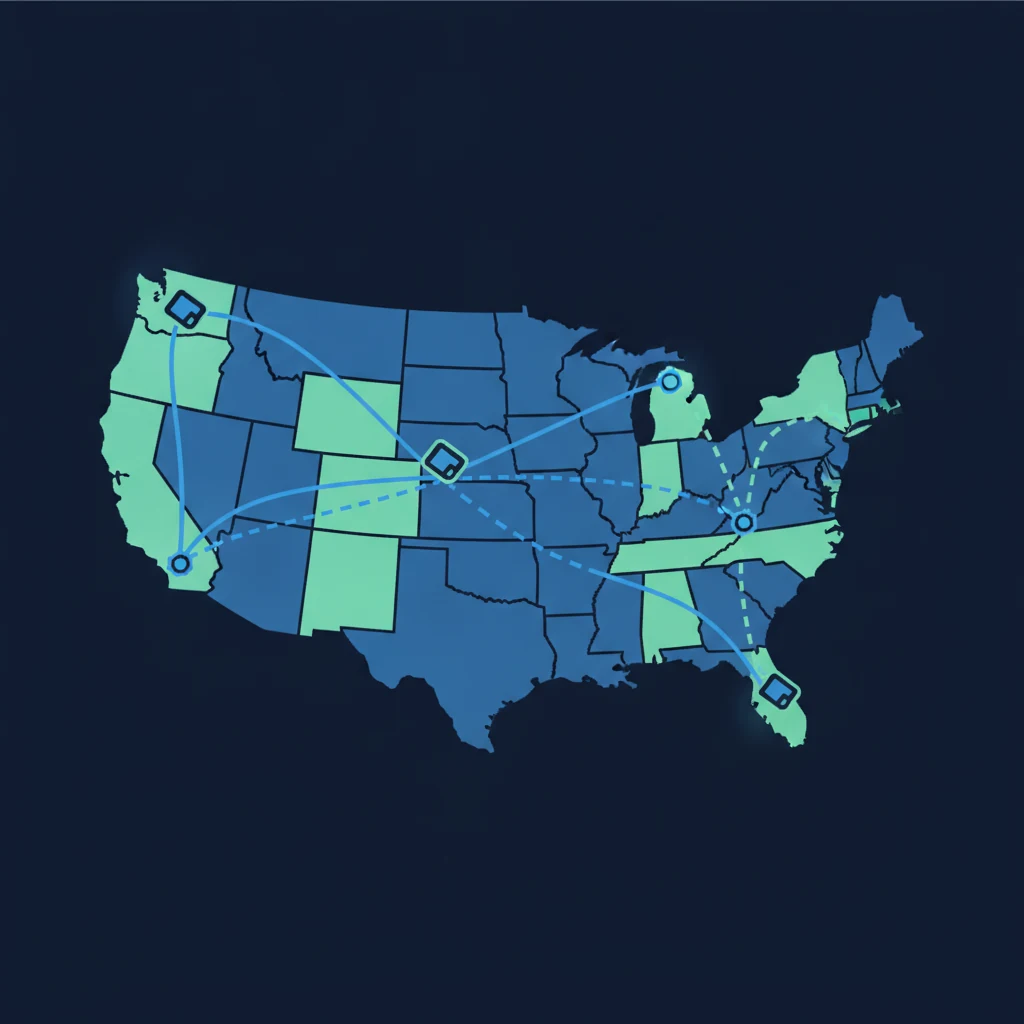
When you move to a new state, your license does not travel with you automatically — and there is no single process for making it count. There are three separate legal mechanisms, they do not overlap, and picking the wrong one is how people lose two or three months to a board application they never actually needed. The three are compact privilege, universal license recognition, and licensure by endorsement. Only one of them lets you skip getting a new license entirely. The other two both end with an application to the destination state's board, but they get there under very different rules.
Here is the distinction that saves the most time: a compact lets you practice on the license you already hold. Endorsement and universal recognition both issue you a new license in the state you're moving to. If your profession has an active compact and both states belong to it, you almost never need the other two paths. Most people don't check for the compact first, so they start an endorsement application by default — the slowest of the three.
The three mechanisms at a glance
| Mechanism | What it does | New license issued? | Typical speed |
|---|---|---|---|
| Compact privilege | Lets you practice in other member states on your existing home-state license | No — you keep your home license | Fastest (often near-instant verification) |
| Universal recognition | Destination state recognizes your out-of-state license as proof you met the requirements | Yes — a new license from the destination state | Weeks to months (application) |
| Endorsement / reciprocity | Destination board issues a new license because your prior requirements were "substantially equivalent" | Yes — a new license from the destination state | Weeks to months (application) |
Mechanism 1: Compact privilege — practice on the license you have
An interstate compact is a binding agreement among states that lets a licensee in good standing practice in any other member state without applying for a new license there. You keep your home-state license; the compact grants a "privilege to practice" in the remote states, usually verified against a shared database in near-real time. This is the only one of the three mechanisms where you do not end up holding a second license.
Where compacts already exist
The most mature example is the Nurse Licensure Compact (NLC), which as of mid-2026 counts roughly 41 states as members, with a couple more enacted but awaiting implementation. NCSBN administers it and keeps the current member list. If you're a nurse moving between two NLC states, you generally don't file an endorsement application at all — your multistate license already covers you.
Compacts aren't just for medical fields
The compact model has spread well beyond nursing. As of 2026, active or enacted occupational compacts include the Counseling Compact (enacted in roughly 40 jurisdictions and issuing practice privileges in a growing subset), the EMS Personnel Licensure Compact (REPLICA), the Interstate Teacher Mobility Compact (around 15 states), and the newer Cosmetology Licensure Compact (12 states as of mid-2026, with multistate applications expected to begin rolling out). The Council of State Governments National Center for Interstate Compacts tracks enactment status across professions. We keep a profession-by-profession version of this in our multistate-compact map, and a deeper look at the counseling side in our Counseling Compact breakdown.
Mechanism 2: Universal license recognition — the 2026 growth story
Universal license recognition (ULR) is a policy a single state adopts on its own to recognize valid out-of-state licenses across a broad range of professions. Unlike a compact, it isn't a multi-state agreement — it's one state unilaterally saying "if you were licensed elsewhere and meet our conditions, we'll license you here without making you repeat the exam or the training." It's the fastest-growing of the three mechanisms: as of early 2026, 28 states plus Puerto Rico had enacted some form of universal recognition, up from about 20 states three years earlier, according to trackers maintained by the Goldwater Institute, which authored the model legislation.
The important catch: it still means an application
Universal recognition is often described as if it were automatic. It isn't. You still apply to the destination state's board and wait for a license to be issued. What "universal" changes is the standard the board uses to evaluate you: instead of re-checking your education and testing you again, it treats your existing license as evidence you already cleared the bar. That usually makes the application faster and more predictable — but it is not the compact model, and you cannot legally start working the day you arrive.
Virginia just tightened the terms in your favor
A concrete 2026 example of how quickly these laws move: Virginia amended its universal-recognition statute, Va. Code § 54.1-205, with changes taking effect in early July 2026. The amendment cut the required period of holding your out-of-state license from three years to one for most applicants, and added a provision recognizing licensees from neighboring jurisdictions — DC, Maryland, North Carolina, Kentucky, Tennessee, and West Virginia — with no minimum time-in-license at all, provided they're in good standing. If you looked at Virginia's rules even a year ago, they've changed in your favor. That's the reason to always read the current statute rather than trust an older summary.
Mechanism 3: Licensure by endorsement — the default path
Endorsement (some boards call it reciprocity) is the oldest and most common route, and it's the one you fall into if the other two don't apply. The destination state issues you a new license because your original state's requirements were "substantially equivalent" to its own — so you submit an application, pay the fees, verify your credentials and history, and skip re-taking the full exam or repeating your education.
What "substantially equivalent" actually gates
The friction in endorsement lives in that phrase. Two states can both license, say, cosmetologists or electricians and still disagree on the training hours, exam vendor, or continuing-education record that counts. If your original state required fewer hours than your destination, the board may ask you to make up the difference before it endorses you. This is why two people from the same origin state can have wildly different endorsement experiences depending on where they're headed.
What slows an endorsement application down
- Verification lag. The destination board has to receive confirmation directly from your original board. If your origin state is slow to send verifications, your application waits regardless of how complete your file is.
- Hours or CE gaps. A shortfall against the destination state's minimums can trigger a make-up requirement.
- Background checks and fingerprinting. Frequently required at endorsement and often the longest single step.
- Board backlog. Processing times swing widely by state and season — the same profession can clear in three weeks in one state and three months in another.
Because endorsement rules are set state-by-state, the details live on your destination board's site, not your origin state's. Our field-tested protocol for reading a board correctly is in how to research a state licensing board, and our state-by-state reciprocity guides map how each profession is treated across all 50 states — for example the cosmetologist reciprocity guide shows which states endorse an existing cosmetology license and which make you re-test.
Which mechanism applies to you: the decision order
Run these in sequence and stop at the first "yes." The order matters because it goes fastest-to-slowest:
- Is there an active compact for my profession, and are both states members and operational? If yes, you likely practice on your existing license — no new application. Confirm the destination state is actually issuing privileges, not just enacted.
- Does my destination state have a universal-recognition law that covers my profession? If yes, you'll apply, but under the streamlined recognition standard. Check the current holding-period and good-standing conditions — they change often, as Virginia shows.
- Neither? You're applying by endorsement. Read the destination board's specific "licensure by endorsement" page for the substantially-equivalent requirements before you pay anything.
What changed in 2026 that's worth knowing
Two trend lines are worth tracking if portability matters to your career. First, universal recognition keeps expanding and softening its terms — Virginia's cut from a three-year to a one-year holding requirement is part of a broader pattern of states lowering the bar to attract licensed workers. Second, the compact map keeps filling in for non-medical fields: cosmetology and teaching now have compacts that barely existed a few years ago, which over time will shift those professions from the slow endorsement path onto the fast compact path. Neither trend is finished, which is exactly why the current statute — not last year's article — is the thing to check.
What to do next
Before you file anything or pay a single fee, write down three facts: (1) whether your profession has an active, operational compact covering both states; (2) whether your destination state has a universal-recognition law and what its current conditions are; and (3) what your destination board's endorsement page lists as substantially-equivalent requirements. Those three answers tell you which of the three mechanisms you're actually using — and in almost every case, they reveal that the default endorsement application isn't your only option. Start with your profession's reciprocity guide to see how your specific credential is treated in the state you're headed to.