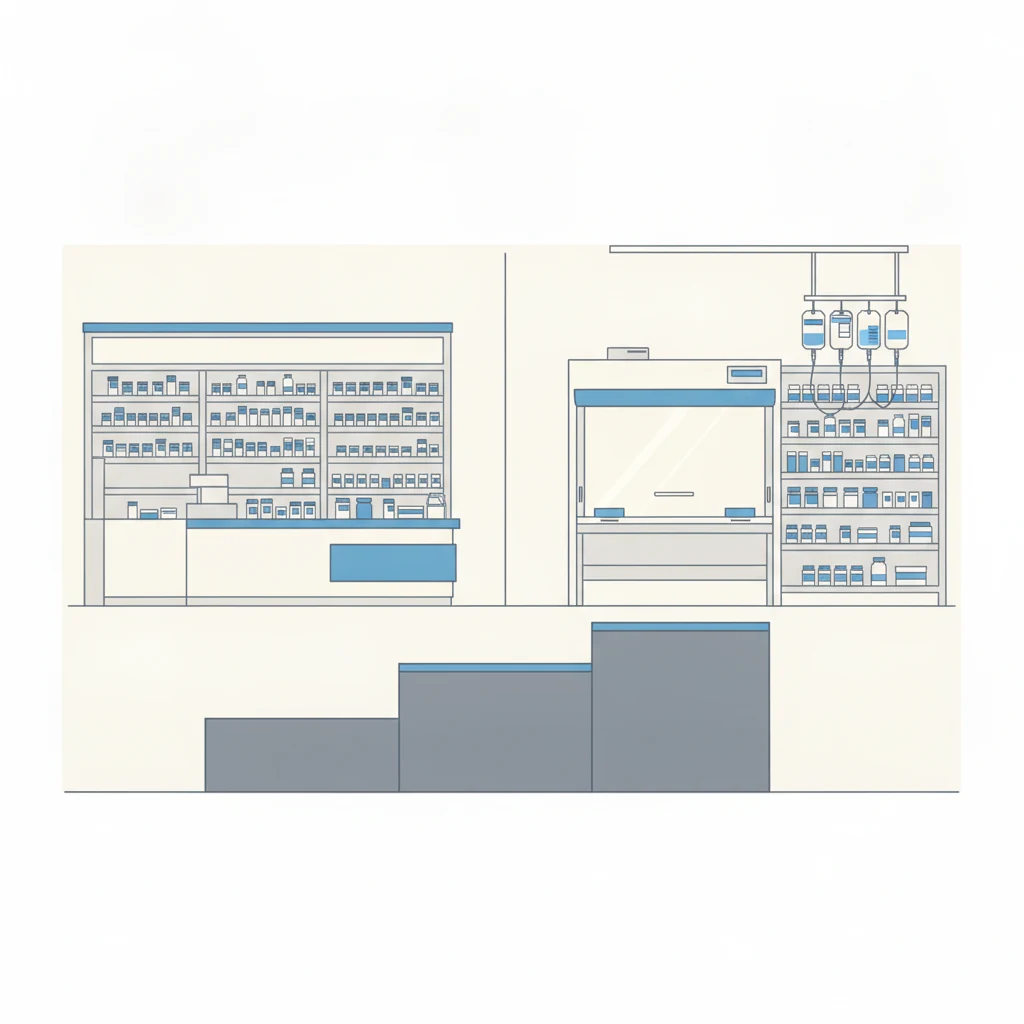
Two people hold the exact same national certification — the CPhT from the Pharmacy Technician Certification Board. One works the counter at a chain drugstore; the other fills IV bags in a hospital cleanroom. On the Bureau of Labor Statistics' own setting breakdown, the drugstore tech's setting pays a median of $37,900. The hospital tech's setting pays $49,310. Same credential, same year, roughly $11,400 apart — and that's comparing the middle of one group to the middle of the other, not cherry-picked extremes.
The number you usually see quoted — a national median of $43,460 — is an average of those two worlds. For most working techs it describes almost nobody. Where you clock in matters more to your paycheck than the certificate on the wall, and that's the single most useful thing to understand before you spend money on a program.
The "median" is really two paychecks in a trench coat
Here's what the site's BLS wage data shows once you stop looking at the single national number and split it by workplace. These are May 2024 Occupational Employment and Wage Statistics medians for pharmacy technicians (SOC 29-2052).
| Where the tech works | Median annual wage |
|---|---|
| Pharmacies & drug retailers (chain/independent) | $37,900 |
| General-merchandise retailers (big-box) | $46,180 |
| Hospitals (state, local & private) | $49,310 |
| Ambulatory healthcare services (clinics, infusion) | $49,920 |
The retail drugstore counter — the setting most people picture when they think "pharmacy tech" — is the lowest-paid corner of the entire occupation. Move the same person into a hospital or an outpatient infusion clinic and the median jumps by about $11,000–$12,000. Nothing about the certificate changed. The employer did.
Where the wider spread comes from
Across the whole occupation the range is even wider: the 10th percentile earns about $35,100 and the 90th about $59,450 — a gap of roughly $24,000. It's tempting to blame that entire spread on setting, but that would be dishonest. The bottom of that range is loaded with part-timers, brand-new hires, and techs in low-wage states; the top is loaded with tenured leads, supervisors, and people in expensive coastal markets. Setting is one lever among several. The clean, like-for-like comparison is median-to-median by workplace — and that alone is worth about $12,000 a year.
Geography stacks on top of setting
The two levers compound. In Washington the median pharmacy tech earns $56,140, with the top tenth clearing $74,370; California's 90th percentile reaches $79,630. At the other end, West Virginia ($37,370), Arkansas ($37,380), and Pennsylvania ($37,560) sit near the national floor. A hospital tech in Seattle and a drugstore tech in rural Appalachia can be separated by more than the price of the certificate program many times over. You can see your own state's number on our pharmacy technician overview, and if you're weighing a move, whether your credential travels is its own question — we cover that in pharmacy tech license reciprocity.
Why the retail floor is sinking — and why that changes the math
Retail pharmacy has always been the low-margin, high-volume tier; that's not new, and the store closures didn't create the wage gap. What's new is that the bottom rung is getting smaller and less stable at the exact moment the pay gap is widest.
The chain-drugstore contraction is real and documented
The retail footprint that historically absorbed most new pharmacy techs is shrinking fast. Rite Aid closed all of its stores by October 2025 after two bankruptcies. Walgreens announced in October 2024 that it would close roughly 1,200 stores over three years. CVS shut about 900 locations between 2022 and 2024 and another 271 in 2025. None of that lowers the retail wage directly — but it means fewer retail seats, more competition for them, and a strong signal to treat the retail counter as a starting line, not a destination.
Demand is not the problem — placement is
This isn't a dying field. BLS projects pharmacy technician employment to grow about 6% from 2024 to 2034 — double the 3% average for all occupations — with roughly 49,000 openings a year. Source: BLS Occupational Outlook Handbook. And automation is not the threat it's made out to be: dispensing robots and inventory software are absorbing the repetitive counting work, which pushes the human role toward compounding, medication histories, and patient-facing tasks that are harder to automate. The risk to your income isn't that the job disappears. It's that you get stuck on the tier where the job pays least.
The credential ladder that actually maps to the top tier
If the higher-paying settings are hospitals, health systems, and specialty pharmacies, the practical question is: what do those employers screen for? The answer is a stack of PTCB credentials beyond the entry-level CPhT — and here it's important to be precise about what they do and don't guarantee.
What sits above the baseline CPhT
- CSPT (Compounded Sterile Preparation Technician) — a standalone certification for sterile IV compounding, the single most portable ticket into hospital and infusion pharmacy.
- Assessment-Based Certificates — shorter PTCB programs in specific competencies: Hazardous Drug Management, Medication History, Medication Therapy Management, Immunization Administration, Point-of-Care Testing, and Technician Product Verification, among others.
- CPhT-Adv (Advanced Certified Pharmacy Technician) — the capstone. It requires an active CPhT, at least three years of experience within the last eight, plus either four Assessment-Based Certificates or three plus the CSPT. There's no separate exam; you assemble it.
How to read a job posting for tier signals
You can usually tell which tier a role belongs to before you apply. Postings that mention sterile/USP <797> compounding, cleanroom, 340B, infusion, or informatics are top-tier signals. Postings built around register, retail workflow, and prescription volume are the floor. If you're early in your career, the move is to take a floor job to bank the experience hours, then use those hours to qualify for the CSPT or an Assessment-Based Certificate and jump settings — rather than waiting for a raise that the retail tier structurally can't give you. That "the ceiling is the setting, not the effort" pattern shows up across credentials; we mapped it in which certifications top out fastest.
So — is the certificate worth it?
Yes, but only if you treat it as step one of a two-step plan. As a terminal credential parked at a drugstore counter, the pharmacy tech certificate lands you in the lowest-paid setting of the field, in a tier that's actively contracting. As the entry ticket to a deliberate move into hospital, infusion, or specialty pharmacy — backed by a CSPT or advanced certificates once you have the hours — it opens a genuinely different income band. The certificate isn't the finish line. The setting is. Plan for the setting from day one, and if you're still comparing this against other short credentials, our highest-paying certs without a four-year degree puts the numbers side by side.
See your state's real numbers first
Wages, licensing steps, and exam costs for pharmacy techs vary widely by state. Check yours before you enroll.
Open the Pharmacy Tech guideFAQ
Does a hospital really pay a pharmacy tech more than a drugstore?
Yes. On BLS May 2024 setting medians, hospitals pay $49,310 and ambulatory healthcare services $49,920, versus $37,900 at pharmacies and drug retailers — roughly an $11,000–$12,000 median difference for the same national certification.
Will getting a CSPT or advanced certificate guarantee a raise?
No. Those credentials qualify you to compete for higher-paying hospital and specialty roles; they don't automatically raise your wage. The advanced (CPhT-Adv) tier also requires three years of experience, so tenure is doing much of the work alongside the certificate.
Is pharmacy tech a shrinking career because of store closures?
The retail segment is contracting — Rite Aid closed all stores by October 2025, and Walgreens and CVS are closing hundreds more — but the occupation overall is projected to grow about 6% through 2034 with ~49,000 openings a year. The growth is concentrated in hospital and clinical settings, not retail.
Do I need a new certification if I move to another state?
Sometimes. The PTCB CPhT is national, but state boards set their own registration and licensing rules on top of it, and they don't all recognize each other automatically. See pharmacy tech reciprocity for how your credential transfers.