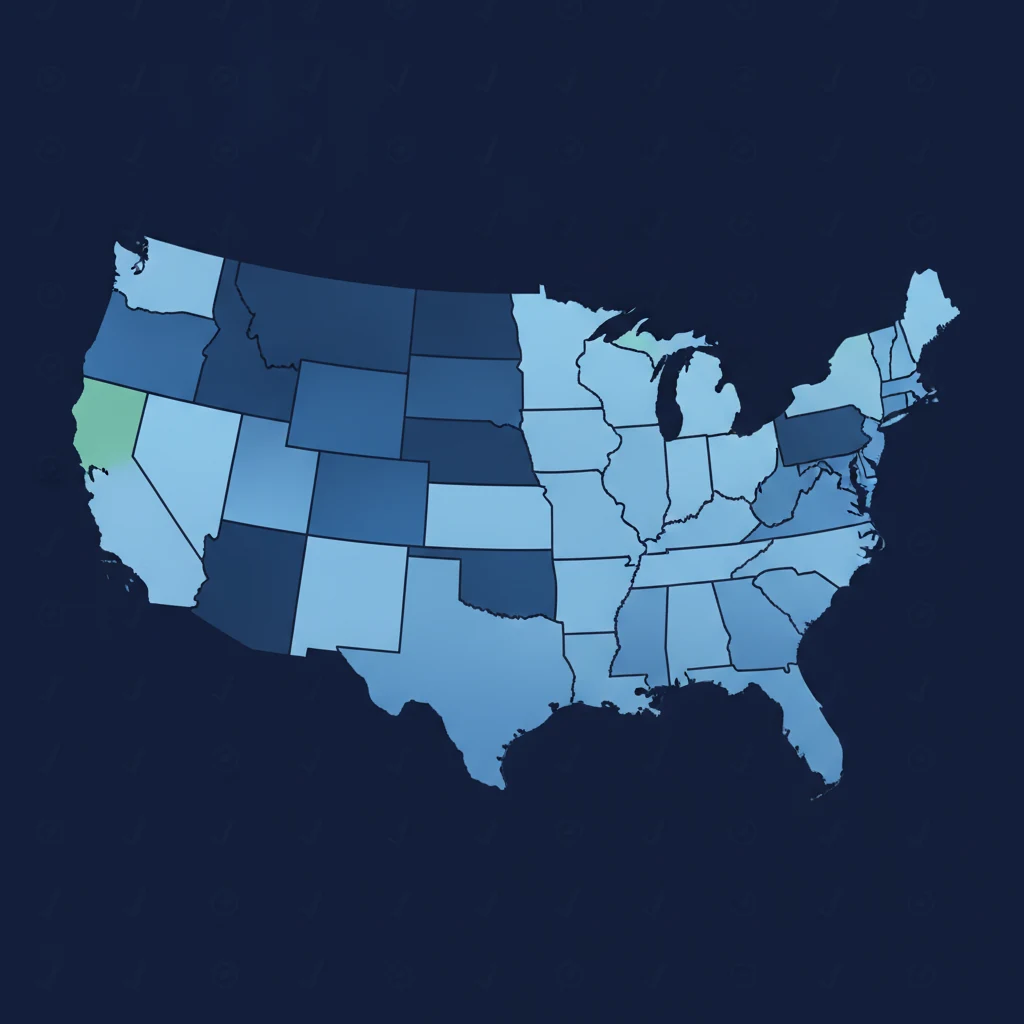
A massage therapist working in Alaska earns a median of $135,200. In Arkansas, the median is $31,280. That's a 4.3x gap for the same credential and the same hands — the kind of number that makes you open a moving-truck quote before you finish reading the sentence.
Don't. That $135,200 is real, but it describes roughly 570 massage jobs in the entire state of Alaska — a market so thin that a single high-end resort corridor can move the median. The barber number is worse: the Bureau of Labor Statistics lists Washington, D.C. barbers at a $102,360 median, the highest in the country, on an employment base BLS effectively rounds to zero. These aren't opportunities. They're statistical ghosts.
The useful question isn't "where does this credential pay the most." It's "if I actually move, does the raise survive contact with a cost-of-living calculator, a real job market, and a licensing board?" For most certifications, the honest answer is no. For a specific few, it's a resounding yes — and they are almost never the ones with the eye-popping headline gap. Here is the 2026 map, built from BLS Occupational Employment and Wage Statistics state medians.
The two numbers that don't survive a second look
Every "highest-paying states for X" list you've read is built the same way: take the top state median, divide by the bottom state median, print the ratio. It's the wrong metric, because the extremes of a 50-state distribution are dominated by three things that have nothing to do with your paycheck: Alaska and Hawaii wage inflation (remote, expensive, tiny labor pools), D.C.'s non-representative economy, and small BLS sample sizes that make thin-market states swing wildly year to year.
Strip Alaska, Hawaii, and D.C. out, then measure the spread between a genuinely high state (90th percentile) and a genuinely low one (10th percentile). The dramatic gaps deflate fast:
| Certification | Headline gap (top ÷ bottom state) | Realistic gap (P90 vs P10 state, ex-AK/HI/DC) |
|---|---|---|
| Massage therapist | 4.3x (AK $135,200 / AR $31,280) | 1.66x (ND $70,720 vs WV $42,730) |
| Barber | 4.25x (DC $102,360 / MS $24,110) | 2.04x (CO $56,690 vs AL $27,850) |
| Real estate agent | 2.68x (NY $97,440 / IA $36,420) | 1.96x (WA $76,980 vs KY $39,270) |
| Firefighter | 2.77x (WA $93,490 / LA $33,700) | 1.91x (IL $79,080 vs WV $41,500) |
| Registered nurse | 2.02x (CA $140,330 / SD $69,510) | 1.33x (NJ $102,730 vs AR $77,130) |
| Physical therapist | 1.43x (CA $123,300 / ND $86,180) | 1.11x (MD $104,330 vs MO $93,750) |
Massage therapy — the poster child for geographic arbitrage a paragraph ago — turns out to have one of the flattest real distributions once Alaska leaves the room. The $103,920 headline spread was almost entirely one state with 570 jobs in it. This is the single most important habit to build before you relocate for money: the top-line number is marketing; the middle of the distribution is your life.
The real pattern is a grid, not a ranking
Once you stop chasing the top number, a cleaner structure appears. Two things vary independently: how much the wage actually spreads across states, and how hard your credential is to move. Licensing friction does not cause the wage spread — local demand, unionization, tipping norms, and cost of living do that. Licensing just decides whether you're allowed to capture it. Cross those two axes and every credential lands in one of three boxes.
The Flatline: portable, but pointless to move for
The nationally standardized credentials — the ones designed to travel — cluster at the bottom of the spread table. A CDL driver's realistic state-to-state gap is about 1.23x. Pharmacy technician: 1.28x. CNA: 1.31x. Phlebotomist and medical assistant: about 1.29x. Physical therapist, despite a six-figure median, spreads only 1.11x across the middle of the country.
These credentials move easily precisely because they're standardized — and standardization is also why the pay doesn't diverge much. If your certification is in this box, relocating for wages is close to mathematically futile. A 20-something-percent nominal bump will usually be eaten whole by the cost of living in the state that's paying it. Move for weather, family, or a specific employer — not for the median. Your reciprocity path is easy, but there's little on the other side worth the U-Haul.
The Friction Trap: the gap is real, but the license won't come with you
Now the uncomfortable box. The credentials with the widest real spread are disproportionately state-issued occupational licenses with no live national portability mechanism: barbers (2.04x), real estate agents (1.96x), firefighters (1.91x), electricians and plumbers (1.4–1.55x), cosmetologists (1.68x). A licensed New York real estate agent's median ($97,440, on a base of more than 10,000 jobs) is a genuine, deep-market premium over Kentucky's $39,270 — and capturing it means re-qualifying under New York's rules, because a real estate license does not transfer on its own.
The compacts that would fix this are, as of late 2026, mostly still on the runway:
- Massage therapy: the Interstate Massage Compact (IMpact) has been enacted in only five states — below the seven-state threshold needed to stand up its commission, and a competing second draft is slowing adoption. No multistate massage license is being issued yet.
- Cosmetology: the cosmetology compact has cleared roughly ten legislatures, but its commission isn't expected to be operational — and issuing multistate licenses — until 2027 at the earliest. Barbers are largely excluded from it.
- Trades: electricians and plumbers have no national compact at all; portability is state-by-state endorsement, and reciprocal agreements are patchy.
So the box that would most reward a move is the box where moving costs you a re-licensing detour. That's the trap: the geographic upside and the licensing friction peak in the same occupations. (You can check any single credential's transfer rules on its reciprocity page — the massage therapist version tracks IMpact state by state — or read the mechanics in our guide to how a license moves between states.)
The Arbitrage Zone: portable and a real gap
The rare, genuinely good box is where a credential both travels and pays meaningfully more somewhere else. Registered nursing is the cleanest example: the Nurse Licensure Compact lets an RN in a member state work across roughly 40 states on one multistate license, and California — outside the compact but a huge, deep market at a $140,330 median across 326,720 jobs — sits well above the pack. Even here the middle-of-distribution spread is a modest 1.33x, which is the honest ceiling on nurse arbitrage: real, capturable, but not the fantasy the CA-vs-SD headline implies. Physician assistants (PA Licensure Compact) occupy the same quadrant with similar modesty.
The three checks to run before you move
If a credential looks like it might genuinely pay more somewhere else, run it through three filters before you commit to anything:
- Kill the outliers. Ignore the single top state. Look at where the 80th–90th-percentile states land versus your current one. If that realistic gap is under ~25%, stop here — it won't survive step two.
- Adjust for cost of living. A nominal raise is not a real raise. California, Hawaii, D.C., and the coastal metros carry the highest wages and the highest prices; a 30% nominal bump into a market where rent is 60% higher is a pay cut. Run the destination through a regional price-parity or cost-of-living calculator before the number means anything.
- Confirm the market exists. A high median on a tiny employment base (Alaska massage, D.C. barbering) is not a job you can reliably get. Check that the destination state actually employs your occupation at volume — thousands of positions, not hundreds — or the high wage is a lottery ticket, not an offer.
Only after a credential clears all three does the fourth question — "can I even get licensed there, and how fast" — become worth answering.
If you're in the Friction Trap, universal recognition is the actual play
For the high-spread, hard-to-move licenses, the mechanism to know about isn't a compact — it's universal license recognition. Roughly a dozen states (Arizona, Pennsylvania, New Jersey, Montana, Utah, Colorado, Missouri, Iowa, Idaho, and a growing list) now have laws requiring their boards to recognize an out-of-state license in good standing without making you repeat school or the exam — typically if you've held the credential for about a year and pass a background check.
That is the difference between "move to the higher-paying state and start over" and "move and be working in a couple of months." But reduced friction is not zero friction. Universal-recognition states still generally require you to establish residency, pay their fees, and sometimes pass a state-specific jurisprudence (law) exam — a process that can still take weeks to months. Military spouses have it easiest: fast-track statutes like California's AB 107 and Nebraska's LB 16 compress the timeline further.
So the sharpest version of the relocation play in 2026 is narrow: a licensed occupation with a real (outlier-adjusted, cost-of-living-adjusted) wage premium, in a destination state that both employs your trade at volume and offers universal recognition. When all of those line up, moving is one of the highest-ROI career moves available. When they don't — which is most of the time — the smarter money stays put and climbs locally.
Check your credential's real numbers
See the state-by-state wage spread and licensing-transfer rules for your specific certification before you make a call.
Browse states & requirementsThe one-line version: the geographic pay gap is real, but it's smaller, rarer, and more concentrated than the headlines claim. Chase the middle of the distribution, not the top of it — and never move on a nominal number you haven't run through a cost-of-living calculator and a licensing board first.