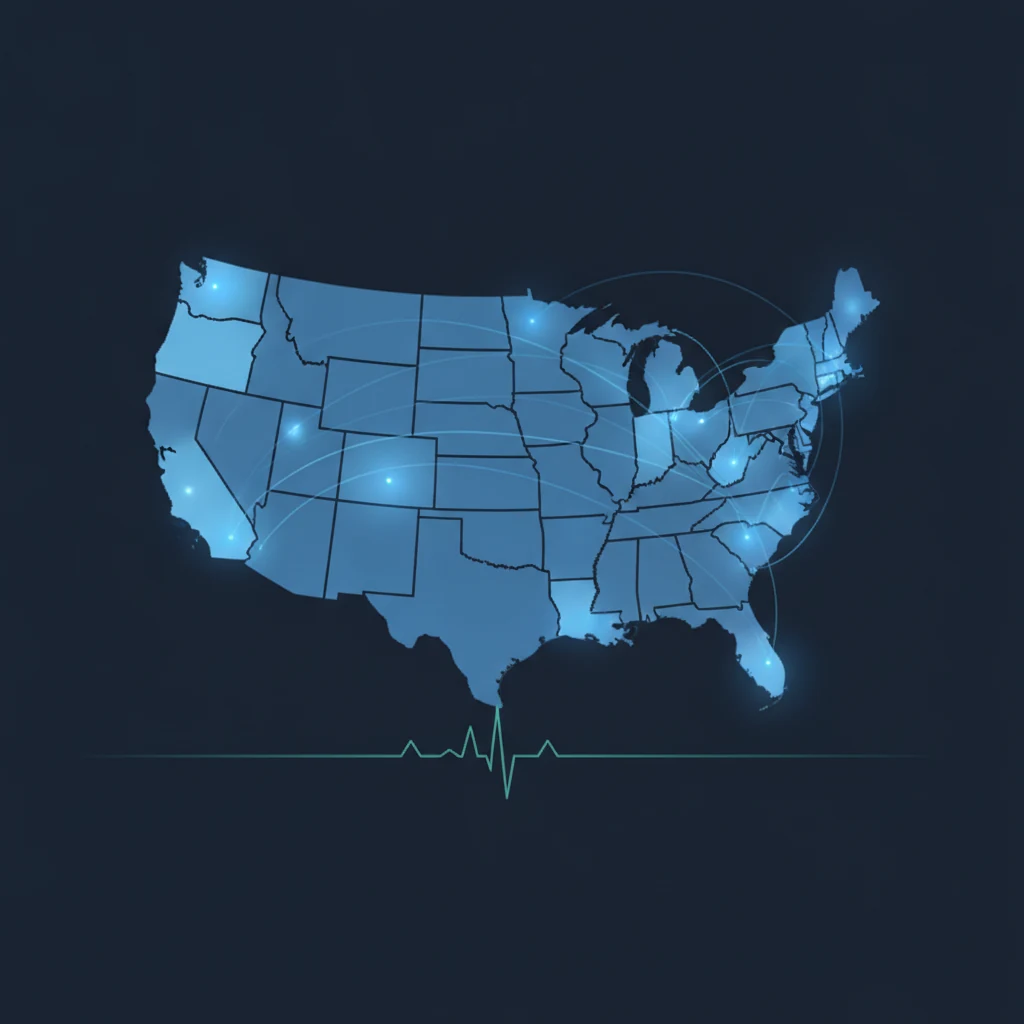
Twenty-eight states have written REPLICA — the interstate compact for EMS personnel — into law. If your home state is one of them and you hold an unrestricted EMT, Advanced EMT, or Paramedic license, you can be granted a privilege to practice in the other member states without applying for a second license in each one. That is the part most providers get right. The part they get wrong is the timing: a state signing the compact and a state actually recognizing your credential are two different events, and in the spring of 2026 three states — Arizona, Connecticut, and Alaska — moved onto the map with very different effective dates.
This is the practical status check for anyone whose work crosses a state line: what the privilege authorizes, which states are in, what it does not cover, and whether the mobility is worth chasing given what EMTs and paramedics actually earn. Facts on the compact below are current as of July 2026 and sourced to the Interstate Commission for EMS Personnel Practice, which runs REPLICA and publishes the authoritative member list. Because membership and operational status change through the year, confirm your two states directly before you accept an assignment across a border.
What REPLICA actually is
REPLICA stands for the Recognition of EMS Personnel Licensure Interstate Compact. It is not a national EMS license and it is not automatic reciprocity. It is a legal framework that lets a member state recognize a credential issued by another member state, administered by a multistate commission that each member appoints a commissioner to.
The "privilege to practice," explained
The privilege to practice is the compact's core mechanism. It authorizes an EMS clinician whose home state is a REPLICA member to work in a "remote" member state — day-to-day calls, patient transport across a line, entering another state to pick up a patient — under the authority of their home-state license. To hold it you must have a current, unrestricted home-state license, be at least 18, and practice under the supervision of a medical director. The privilege has no built-in time limit; it is meant for ongoing cross-border practice, not just the occasional call.
Enacted is not the same as your license working
This is the single most expensive misread in the compact world, and it is not unique to EMS — the counseling and social-work compacts have the same trap. A state "enacts" REPLICA the day the bill is signed. Whether a specific state is fully operational — connected to the national coordinated database, with its board recognizing privileges — can lag the signature. The three 2026 additions show exactly how uneven that timeline is:
- Arizona — Governor Hobbs signed SB 1235 into law on May 22, 2026.
- Connecticut — enacted as part of Public Act 26-13; the state's participation is conditioned on a bordering state also joining, so activation is contingent rather than immediate.
- Alaska — passed in the omnibus licensing bill HB 110, which became law without the governor's signature on June 23, 2026, with an effective date of January 1, 2027.
Three states "joined" in a two-month window, and not one of them means "you can work there this week." Treat enactment as a signal that a state is on its way in — then verify its live status before you rely on it. For the same enacted-versus-live gap across counseling, nursing, social work, and the trades, see our map of which credentials actually travel between states in 2026.
The member states, as of mid-2026
Twenty-eight states have enacted REPLICA. The roster runs heavily through the Mountain West, Plains, and South — Texas, Colorado, Utah, Idaho, Kansas, Nebraska, the Dakotas, Oklahoma, Missouri, Arkansas, Louisiana, Mississippi, Alabama, Tennessee, Georgia, South Carolina, Virginia, West Virginia, Delaware, Pennsylvania, Nevada, Wyoming, and Indiana — with Arizona, Connecticut, and Alaska joining in 2026. Notably absent are several of the largest states: California, New York, Florida, Ohio, Michigan, and Washington are not members, so an EMT licensed there has no privilege to extend and no privilege to receive.
What the privilege does not cover
The phrase "my license travels" oversells it. Four limits decide whether REPLICA actually helps you.
It only works if your home state is a member
Your entry point into the compact is the state where you primarily reside and hold your license. If that state has not enacted REPLICA, you get nothing from the compact — regardless of how many other states are in. This is why the roster's absences matter as much as its members.
It is for EMTs, AEMTs, and paramedics — not EMRs
The privilege covers three license levels: EMT, Advanced EMT, and Paramedic. Emergency Medical Responders — the entry tier below EMT — are outside the compact. If you hold an EMR credential, REPLICA does not apply until you move up a level.
It covers people, not agencies or vehicles
REPLICA governs individual clinicians. It does not license EMS agencies, ambulances, or aircraft, which remain subject to the rules of the state they operate in. A flight medic's personal privilege travels; the aircraft's operating authority is a separate question handled entirely outside the compact.
The remote state still holds power over you
When you practice on a privilege, you are bound by the remote state's scope of practice and rules, not your home state's, unless the remote state chooses to modify them. And while only your home state can act against your actual license, a remote state can investigate complaints and revoke your privilege to practice within its borders. The compact moves the paperwork; it does not export your home state's rulebook or shield you from local discipline.
Does the mobility actually pay?
Portability is only worth chasing if the destinations pay more, and EMS wages have a wide enough spread that they can. Nationally, the numbers are modest and the gap between EMTs and paramedics is the real story:
| Credential | 10th pct | Median | 90th pct |
|---|---|---|---|
| EMT | $31,410 | $41,340 | $60,780 |
| Paramedic | $40,130 | $58,410 | $82,420 |
Those are national figures from the BLS Occupational Employment and Wage Statistics (May 2024), the same source behind our EMT and paramedic career pages. The honest read: REPLICA does not raise your base pay. What it removes is the licensing friction that otherwise blocks the two moves that do raise it — taking a travel-EMS or disaster-deployment contract in a higher-wage state, and working a metro market that straddles a state line without maintaining two full licenses. For a paramedic sitting near the median, the difference between the 50th and 90th percentile is roughly $24,000 a year, and a chunk of that gap is geographic. The compact is what lets you go get it without re-licensing.
Who should actually care
REPLICA is a background convenience for most providers and a genuine lever for a few. It matters most if you are:
- A border-region provider whose nearest calls, hospitals, or transfers routinely cross into the next state.
- Taking travel or contract EMS work, where the ability to deploy into a member state on short notice — without a months-long licensure application — is the whole value proposition.
- Part of mutual-aid or disaster response, where crews move across lines during declared events.
- A relocating military spouse or a new grad choosing where to license, weighing which home state keeps the most doors open.
If none of those describe you, the compact is a nice-to-have you can safely ignore until your situation changes. If one of them does, it belongs in the same decision as pay, demand, and training time — not ahead of them. Our framework for scoring any credential puts portability in that context.
Frequently asked questions
My state just joined the EMS Compact. Can I work across state lines now?
Only if your home state is an operational member and the state you want to work in is too. Enactment and operational status are different milestones, sometimes more than a year apart. Arizona signed in May 2026, Connecticut's activation is conditioned on a bordering state joining, and Alaska's takes effect January 1, 2027 — three "new" states, three different timelines.
Does REPLICA cover Emergency Medical Responders (EMRs)?
No. The privilege to practice covers EMTs, Advanced EMTs, and paramedics only. EMRs are not included in the compact.
If I move to a different state, does my privilege move with me?
Not automatically. The privilege is tied to your home-state license, and your home state is where you primarily reside. Relocate, and your home state changes — you need a qualifying license in the new home state, which must itself be a member, before the compact works from there.
Is a privilege the same as getting a second license?
Functionally similar, legally not identical. A privilege lets you practice in a remote member state under that state's rules without a full license application, but it is attached to your home license — if the home license lapses or is disciplined, the privilege goes with it.
Before you rely on it
Do one thing before you accept a cross-line assignment: pull up the Commission's member list and confirm, in writing, that both your home state and your destination are current members recognizing privileges — not merely enacted. Three states changed status in the second quarter of 2026 alone. If you want to double-check your own board's licensing tier and standing while you are at it, our protocol for researching a state licensing board covers where to confirm both. A mobility plan built on last quarter's map is a plan built on a state that may still be months from going live.